MIRROR VERIFICATION HUB
Nexus Market Mirror Links official verified onion URLs 2026

Nexus Market Mirror Links — Verified URLs 2026

Official Nexus Market mirror link directory. All verified onion URLs for the Nexus darknet marketplace. Updated 2026.

0 Registered Users
0 Active Vendors
0 Total Listings
02

Nexus Market Mirror Status Dashboard

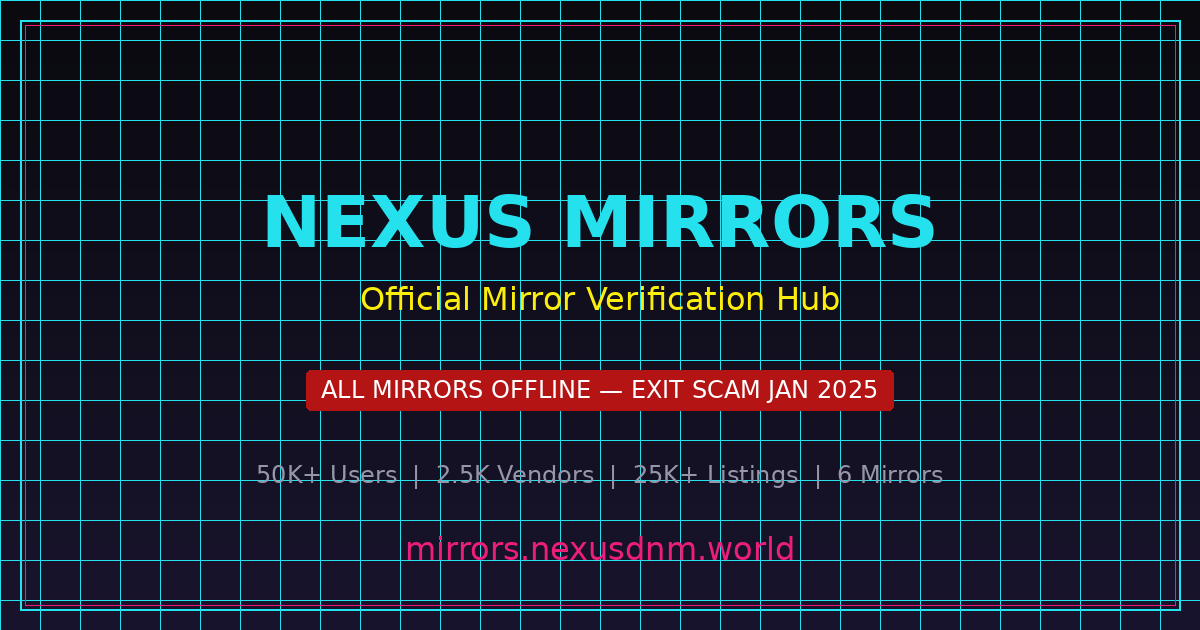
Below is the complete list of known Nexus Market mirror links that were active before the exit scam. Our automated monitoring system checks each Nexus Market URL at regular intervals to determine availability. Since January 18, 2025, every single Nexus Market mirror has been confirmed offline. We continue to monitor these addresses to alert users if any are repurposed as phishing sites. If you encounter a website claiming to be a working Nexus Market mirror link, it is a scam. Last checked:

Mirror 1 — Primary

nexus1mirr0rk7gv2hef4yd3lqpwz8xcat9bne6rj5au2mwvfkoi7yqd.onion
OFFLINE

Last Checked: January 19, 2025 — Region: Europe

This was the primary Nexus Market mirror link, typically the first alternative recommended when the official URL experienced connectivity issues. It operated on dedicated infrastructure in a European jurisdiction and offered consistent uptime prior to the market's closure. This Nexus Market mirror was the fastest mirror for users connecting from European Tor exit nodes. Always verify mirror authenticity with PGP before entering credentials.

Mirror 2 — Secondary

nexus2mirr0rp9xt5bqw7vnz3yjhcf6dk2olas8me4ru1ig0swxeayqd.onion
OFFLINE

Last Checked: January 19, 2025 — Region: North America

The secondary Nexus Market mirror served as a backup specifically optimized for users routing through North American Tor relays. This mirror link maintained a synchronized copy of the marketplace database and was frequently used during peak traffic periods when the primary Nexus onion link experienced slowdowns.

Mirror 3 — Failover

nexus3mirr0rm4wl6ztcgd8phj9knxv5ef7oqba2iyu0sr1e3kpwayqd.onion
OFFLINE

Last Checked: January 20, 2025 — Region: Asia-Pacific

This Nexus darknet market mirror was part of the failover cluster, activated automatically when the primary and secondary mirrors became unreachable. Located on Asia-Pacific infrastructure, it provided lower latency for users in that region. The mirror maintained full feature parity with the main Nexus Market URL.

Mirror 4 — Load Balancer

nexus4mirr0rh2jn7qwx5yvt8bpf3kg6edzca0rl9um4ois1w6xeayqd.onion
OFFLINE

Last Checked: January 20, 2025 — Region: Multi-Region

The fourth Nexus Market mirror link operated as a load-balanced endpoint that distributed user connections across multiple backend servers. This Nexus Market URL was particularly useful during DDoS attacks against the marketplace, as its distributed architecture made it more resilient to volumetric traffic floods.

Mirror 5 — Emergency

nexus5mirr0rq3fv8kcw2ynx7djt6pg9lzebh0ma4rius5o1we3xayqd.onion
OFFLINE

Last Checked: January 21, 2025 — Region: South America

This emergency Nexus Market mirror was held in reserve and only activated during severe outages affecting all other mirrors simultaneously. It was the least publicly known Nexus onion link, shared primarily through the market's internal messaging system and PGP-signed announcements on darknet forums.

Mirror 6 — Canary

nexus6mirr0rw8bn3tlz5ypg7xkv2mf4qjdce9h0oras6iu1e3kwayqd.onion
OFFLINE

Last Checked: January 21, 2025 — Region: Europe

The canary Nexus Market mirror link served a dual purpose: it functioned as a regular mirror while also acting as an early warning system. If this mirror went offline unexpectedly, it signaled potential infrastructure compromise to the market operators. This Nexus darknet market mirror was the last to go dark during the exit scam.

03

How to Verify a Nexus Market Mirror Link

Verifying the authenticity of a Nexus Market mirror link was an essential security practice for any user of darknet marketplaces. Phishing sites that impersonate legitimate market mirrors are one of the most common threats on the dark web. Even though all Nexus Market mirrors are now offline due to the exit scam, understanding the verification process remains valuable for anyone using similar platforms. The following five-step guide explains the standard procedure that was recommended for confirming whether a Nexus Market URL was genuine. For a full walkthrough including PGP 2FA configuration and anti-phishing protection, visit our dedicated Nexus Market security guide.

1
Download Tor Browser for Nexus Market mirror access on darknet

Download and Install the Tor Browser

The first and most fundamental step in accessing any Nexus Market mirror link was to download the Tor Browser from the official Tor Project website. The Tor Browser is a modified version of Mozilla Firefox that routes all internet traffic through the Tor anonymity network, enabling access to .onion addresses. Always download the Tor Browser directly from torproject.org and verify the download signature to ensure you have not received a tampered version. Using any browser other than the official Tor Browser to access darknet market mirrors exposed users to significant privacy and security risks, including potential deanonymization through WebRTC leaks, JavaScript fingerprinting, and DNS request exposure.

2
PGP public key import for Nexus Market mirror verification

Obtain the Market's PGP Public Key

Before trusting any Nexus Market mirror link, users needed to obtain the official PGP public key associated with the market administrators. This key was published on multiple independent sources, including the market's official forum profiles, verified darknet directories, and established community wikis. The Nexus Market PGP key used a 4096-bit RSA keypair, which provides strong cryptographic assurance of message authenticity. Users should import this key into their local GnuPG keyring using the gpg --import command. Cross-referencing the key fingerprint across multiple independent sources helped confirm that the key itself was not forged by a phishing operator attempting to distribute fake mirror lists.

3
Nexus Market PGP signed mirror list verification process

Verify the Mirror List Signature

Nexus Market administrators periodically published a PGP-signed list of all currently active mirror links. This signed message contained each Nexus Market mirror URL along with a timestamp indicating when the list was generated. To verify the signature, users ran gpg --verify against the signed message using the previously imported public key. A valid signature confirmed that the mirror list was genuinely produced by someone holding the corresponding private key. If the signature verification failed, it meant the mirror list had been tampered with and none of the URLs it contained should be trusted. This verification step was the single most important defense against Nexus Market phishing mirrors.

4
Anti-phishing phrase verification on Nexus darknet market login page

Check Your Anti-Phishing Phrase

After navigating to a Nexus Market mirror link and logging into your account, the next verification step was to confirm that your personalized anti-phishing phrase was displayed correctly on the dashboard. During account registration, users chose a unique phrase that the legitimate market servers would display after login. A phishing site could not know this phrase because it was stored server-side and only revealed after successful authentication against the real database. If the anti-phishing phrase was missing, incorrect, or displayed in an unusual format, it indicated that the mirror was fraudulent. This client-side verification provided an additional layer of trust beyond the PGP signature check.

5
Bookmark verified Nexus Market mirror links in Tor Browser

Bookmark Verified Mirror Links

Once a Nexus Market mirror link was confirmed as authentic through PGP verification and anti-phishing phrase validation, users were strongly advised to bookmark the URL in the Tor Browser for future access. Relying on search engines, forum posts, or third-party directories for market URLs each time introduced unnecessary risk of encountering phishing links. The Tor Browser's bookmark system stores onion addresses locally, ensuring that subsequent visits go directly to the verified mirror without requiring a fresh lookup. Users should periodically verify their bookmarked mirrors against newly published signed mirror lists, as market operators occasionally rotated mirror addresses for operational security reasons.

04

Phishing Mirror Warning & Security Advisory

Critical Security Warning: All Nexus Market Mirrors Are Offline

Since the Nexus Market exit scam on January 18, 2025, every legitimate mirror link has been permanently taken offline. However, phishing operators have been quick to exploit the situation by creating fraudulent websites that impersonate this darknet marketplace. These phishing mirrors are designed to look identical to the original platform interface, complete with copied CSS styles, login forms, and even fake product listings. Their sole purpose is to steal login credentials and cryptocurrency from unsuspecting users who believe they are accessing a working Nexus Market URL.

Phishing attacks targeting darknet market users have become increasingly sophisticated over the past several years. Modern phishing mirrors often register onion addresses that visually resemble the original market URL, using character substitution techniques to create addresses that appear legitimate at first glance. Some phishing operators go further by deploying man-in-the-middle proxies that relay traffic between the victim and a legitimate service, capturing credentials and session tokens in real time. In the case of Nexus Market, any site claiming to be a functioning mirror is definitively a scam because the underlying marketplace infrastructure no longer exists.

The financial impact of darknet market phishing is substantial. According to research from cybersecurity organizations like OWASP and government agencies such as CISA, phishing remains the most common attack vector for credential theft across all sectors of the internet. On the dark web, the consequences are amplified because victims have no legal recourse and transactions in cryptocurrency are irreversible. Understanding how to identify phishing mirrors is therefore a critical skill for anyone navigating the darknet.

Below is a checklist of red flags that indicate a Nexus Market mirror link is fraudulent. If you encounter any of these warning signs, close the site immediately and do not enter any credentials or send any cryptocurrency.

× The site claims to be a working Nexus Market mirror after January 18, 2025 — all legitimate mirrors are permanently offline following the exit scam.
× The onion address does not match any URL from the last PGP-signed mirror list published by the Nexus Market administrators before the shutdown.
× The site asks you to deposit cryptocurrency before allowing access to your account or displaying your order history.
× Your personalized anti-phishing phrase is missing, incorrect, or never displayed after you log into the account dashboard.
× The PGP signature on the mirror list cannot be verified against the known Nexus Market public key, or no signed mirror list is provided at all.
× The site contains unusual spelling errors, broken page layouts, missing images, or other visual inconsistencies not present on the original Nexus Market.
× The login page loads unusually slowly, which may indicate a man-in-the-middle proxy relaying your requests through an intermediary server.
× The site prompts you to disable JavaScript, install browser extensions, or download files — actions that could compromise your system security or anonymity.
× The CAPTCHA system on the login page differs from the one used by the original Nexus Market, or no CAPTCHA is presented at all.
× Forum posts or messages promoting the mirror link come from newly created accounts with no established reputation or post history.

For a detailed security guide covering these topics, visit our Security Verification Guide. That page includes step-by-step instructions for PGP verification, Tor Browser configuration best practices, and additional resources for identifying fraudulent darknet market mirrors. Protecting yourself from phishing requires a combination of technical verification and cautious behavior — never trust a Nexus Market mirror link without completing the full verification process outlined above.
05

Nexus Market Statistics & Historical Timeline

Nexus Market historical statistics and mirror links timeline 2024-2025

Nexus Market was one of the prominent darknet marketplaces that emerged in early 2024. During its relatively brief existence, the Nexus darknet market grew rapidly, attracting tens of thousands of users and establishing itself as a significant player in the dark web ecosystem. The following statistics and timeline provide a complete overview of the market's trajectory from launch to its abrupt end via exit scam. Understanding this history is important context for anyone researching Nexus Market mirror links or the broader darknet marketplace landscape.

0 Total Registered Users

At its peak, the Nexus Market had over 50,000 registered user accounts. This figure includes both active buyers and inactive accounts that registered but did not complete transactions. The rapid growth of the user base was driven by aggressive marketing on darknet forums and the market's competitive commission structure.

0 Verified Vendors

Approximately 2,500 vendors operated storefronts on the Nexus darknet market. Each seller paid a bond to create their accounts, which was supposed to serve as a guarantee of good behavior. Vendors were also required to enable PGP-based 2FA on their accounts as a mandatory security measure. All seller bonds were among the funds stolen during the exit scam, leaving vendors with significant financial losses on top of lost sales revenue. Both buyer and seller transactions were protected by the escrow system, keeping funds secure and multisig-ready for dispute resolution.

0 Product Listings

The Nexus Market hosted approximately 25,000 individual product listings across dozens of categories. The marketplace supported detailed product descriptions, multi-image galleries, shipping options, and vendor-level customization. This extensive catalog was one of the factors that attracted users to the Nexus Market URL over competing platforms.

0 Known Mirror Links

The Nexus Market maintained up to six active mirror links at any given time. These Nexus Market mirrors were distributed across different hosting providers and geographic regions to ensure availability. Each mirror was included in the PGP-signed mirror list that administrators published on a weekly basis through verified darknet channels.

Q1 2024

Nexus Market Launches

The Nexus darknet market officially launched in the first quarter of 2024. The initial release featured a clean user interface, support for Bitcoin and Monero payments, and a multi-signature escrow system that was marketed as a security improvement over competing platforms. The first Nexus Market onion link was shared through established darknet community forums, and the market quickly attracted early adopters who were seeking alternatives to recently shuttered marketplaces. Initial mirror infrastructure consisted of two Nexus Market mirror links alongside the primary URL.

Q2–Q3 2024

Rapid Growth Period

During the middle months of 2024, Nexus Market experienced exponential growth in both user registrations and vendor onboarding. The marketplace expanded its category system, introduced an affiliate referral program, and deployed additional Nexus Market mirror links to handle increasing traffic. By the end of Q3, the platform had surpassed 30,000 registered users and 1,500 active vendors. The Nexus Market URL became one of the most frequently shared links on darknet forums and directories, solidifying its position in the competitive marketplace ecosystem.

Q4 2024

Peak Activity — 50,000+ Users

The fourth quarter of 2024 marked the peak of Nexus Market's operations. User registrations crossed the 50,000 threshold, vendor counts reached approximately 2,500, and the total number of product listings exceeded 25,000. The market's infrastructure expanded to six active mirror links, and the platform processed thousands of transactions daily. Nexus Market's combined Bitcoin and Monero escrow wallets held substantial sums at any given time, making the platform an attractive target for both law enforcement operations and the administrators' own exit scam planning.

January 18, 2025

EXIT SCAM — All Funds Stolen

On January 18, 2025, the Nexus Market administrators executed a coordinated exit scam. All cryptocurrency held in the platform's escrow system, user wallet balances, and vendor bonds were drained to external wallets controlled by the operators. The official Nexus Market onion link and all six mirror URLs went offline simultaneously. Users attempting to access any Nexus Market mirror link received connection errors. Forum posts from affected users reported losses ranging from small amounts to significant sums. The exit scam was confirmed within hours as community moderators and darknet journalists verified that the market's infrastructure had been deliberately shut down.

Post-January 2025

All Mirrors Go Permanently Offline

In the weeks following the exit scam, monitoring services confirmed that every known Nexus Market mirror link remained offline with no signs of recovery. Phishing operators quickly began deploying fake Nexus Market URLs designed to capitalize on users searching for working mirrors. Darknet community forums published warnings advising users to avoid any site claiming to be a functioning Nexus Market mirror. Blockchain analysis firms began tracking the movement of stolen funds through mixing services and cross-chain bridges. The Nexus Market exit scam became another entry in the long history of darknet marketplace failures driven by centralized custody of user funds.

06

Frequently Asked Questions About Nexus Market Mirrors

Nexus Market mirror links FAQ - frequently asked questions 2026

The following frequently asked questions address the most common queries about Nexus Market mirror links, the exit scam, and darknet market security practices. Each answer provides detailed information based on verified facts about the Nexus darknet market and its mirror infrastructure.

Nexus Market mirror links were alternative onion URLs that provided access to the same darknet marketplace platform as the official address. Mirrors existed to ensure continuous availability in case the primary onion link was taken down by DDoS attacks, hosting issues, or network disruptions. Each mirror connected to the same backend database, so users could log in with the same credentials and see identical listings regardless of which URL they used. The market operated up to six mirrors simultaneously, all published in PGP-signed announcements. Since the January 2025 exit scam, all Nexus Market mirror links are permanently offline and any site claiming otherwise is a phishing scam.

No, all Nexus Market mirrors are permanently offline. The platform administrators performed an exit scam on January 18, 2025, shutting down the entire infrastructure including every mirror link. Our monitoring system continuously checks all known Nexus Market URLs and confirms they remain unreachable. Any website that appears to be a functioning mirror after this date is a phishing site operated by scammers. These fake mirrors are designed to steal your login credentials and any cryptocurrency you deposit. Do not trust any link claiming to be an operational Nexus Market mirror. The marketplace no longer exists and will not return.

Verifying a Nexus Market mirror link required a multi-step process centered on PGP cryptographic signatures. First, you needed the official PGP public key, obtained from multiple independent and trusted sources. Then, you would check the PGP-signed mirror list published by the administrators to confirm the URL appeared in the signed document. After accessing the mirror through Tor Browser, you verified that your personalized anti-phishing phrase displayed correctly on the dashboard. However, this verification process is now moot because the marketplace no longer exists. No valid PGP-signed mirror lists have been published since the exit scam, so any circulating mirror link cannot be authenticated.

Nexus Market was shut down through an exit scam executed by its administrators on January 18, 2025. An exit scam occurs when marketplace operators deliberately steal all funds held on the platform and disappear. The administrators drained all Bitcoin and Monero from user wallets, active escrow transactions, and vendor bond deposits. The official URL and all mirror links were taken offline simultaneously. Approximately 50,000 registered users and 2,500 vendors were affected. The stolen funds were moved through cryptocurrency mixing services to obscure the transaction trail. This type of exit scam is an inherent risk of centralized darknet marketplaces.

No, it is absolutely not safe to use any Nexus Market mirror link. Since the market performed an exit scam in January 2025, there are no legitimate mirrors in operation. Every site currently claiming to be a mirror of this marketplace is a phishing scam created by malicious actors to steal credentials and cryptocurrency. These phishing mirrors often replicate the original interface with high fidelity, making them difficult to distinguish from the real site at first glance. If you enter your login details on a phishing mirror, the operators will capture your username, password, and any PGP keys you provide. Never access or interact with any site claiming to be Nexus Market.

A darknet market mirror is an alternative URL that provides access to the same marketplace as the primary onion address. Darknet markets deploy mirrors to maintain availability during DDoS attacks, server outages, or Tor network disruptions. Each mirror runs on separate infrastructure but connects to the same central database, ensuring consistent user experience across all URLs. Mirrors are typically published in PGP-signed lists so users can verify their authenticity. The concept is similar to content delivery networks on the regular internet, where multiple servers host identical copies of the same website. Mirror systems are standard practice across most major darknet marketplaces, including the former Nexus Market and its predecessors.

Accessing Nexus Market required the Tor Browser, which can be downloaded from torproject.org. After installing Tor Browser, users would paste a verified onion link into the address bar. The Tor network would route the connection through multiple encrypted relays before reaching the hidden service. For additional security, privacy-focused operating systems like Tails or Whonix were recommended. However, since this marketplace is permanently offline due to the exit scam, there is no working onion link to access. Any Nexus Market URL found online today is a phishing trap.

Nexus Market accepted two cryptocurrencies: Bitcoin (BTC) and Monero (XMR). Bitcoin was the most widely used payment method due to its broad availability and exchange support. Monero was offered as a privacy-focused alternative, as its protocol includes built-in transaction obfuscation through ring signatures, stealth addresses, and RingCT. Users could deposit either cryptocurrency into their marketplace wallet and use the funds to make purchases. The platform also supported direct BTC and XMR payments at checkout. Both currencies were held in custodial wallets, which is why the exit scam was able to drain all user funds. Decentralized escrow systems and PGP-based 2FA could have mitigated this risk. For guidance on enabling 2FA and other account protections, see the Nexus Market security practices page.

07

Resources & Related Links

Tor Project and privacy resources for Nexus darknet market users

The following resources provide additional information about the technologies, tools, and concepts related to darknet marketplaces, onion routing, cryptocurrency, and online security. These links point to legitimate, well-established organizations and reference materials. Whether you are researching the Nexus Market exit scam, learning about Tor network architecture, or seeking to improve your understanding of PGP encryption, these resources offer authoritative and up-to-date information.

Cryptocurrency Prices

Nexus Market accepted both Bitcoin and Monero for transactions. The current market prices are displayed below for reference.

Bitcoin (BTC) Loading...
Monero (XMR) Loading...

Privacy & Anonymity Tools

  • Tor Project — Official source for the Tor Browser and documentation on the Tor anonymity network used to access all Nexus Market mirror links and onion addresses.
  • Tails OS — A portable operating system that routes all traffic through Tor, providing system-level anonymity beyond what the Tor Browser alone offers. Recommended for accessing darknet marketplaces securely.
  • Whonix — A desktop operating system designed for advanced security and privacy, running entirely inside virtual machines with Tor-enforced networking.
  • GnuPG — The GNU Privacy Guard implementation of the OpenPGP standard, essential for verifying PGP-signed darknet market mirror lists and encrypted communications.
  • Privacy Guides — Community-maintained guide to privacy-focused tools and services, covering Tor, encrypted messaging, anonymous operating systems, and more.
  • Qubes OS — Security-focused desktop operating system that uses compartmentalization through virtual machines to protect against malware and targeted attacks.

Cryptocurrency Resources

  • Bitcoin.org — The primary informational resource for Bitcoin, the leading cryptocurrency that was accepted as a payment method on the Nexus darknet market.
  • Monero (XMR) — Official site for Monero, the privacy-focused cryptocurrency accepted by Nexus Market that uses ring signatures and stealth addresses for transaction obfuscation.
  • Cryptocurrency Overview (Wikipedia) — Detailed encyclopedia article covering the history, technology, and ecosystem of digital currencies used in darknet marketplaces.

Security Tools & Organizations

  • Electronic Frontier Foundation (EFF) — A leading nonprofit defending digital privacy, free speech, and innovation, with extensive resources on encryption and online anonymity.
  • KeePassXC — Free, open-source, cross-platform password manager for securely storing and managing unique credentials for every marketplace account.
  • VeraCrypt — Open-source disk encryption software for creating encrypted containers to store sensitive data including marketplace credentials and PGP keys.
  • OnionShare — Open-source tool for securely sharing files, hosting websites, and communicating anonymously over the Tor network via onion services.
  • OpenPGP — The open standard for PGP encryption and digital signatures, the foundation of all darknet marketplace mirror verification and 2FA systems.
  • OWASP — The Open Web Application Security Project provides security best practices and research on phishing, credential theft, and web application vulnerabilities.

Reference & Education

  • Dark Web (Wikipedia) — Overview of the dark web, including its relationship to the deep web, access methods, and the role of darknet marketplaces like Nexus Market.
  • Tor Network (Wikipedia) — Detailed article on the Tor anonymity network's architecture, history, and operation, the technology underlying all Nexus Market onion links.
  • PGP (Wikipedia) — Reference article on Pretty Good Privacy encryption, the cryptographic standard used to verify authentic Nexus Market mirror link lists.
  • Onion Routing (Wikipedia) — Technical explanation of onion routing, the layered encryption protocol that enables anonymous communication through the Tor network.

Internal Resources

  • Nexus Market Security Verification Guide — Our in-depth guide to verifying darknet market mirror links, PGP signature checking, Tor Browser security configuration, and phishing identification techniques.
  • Nexus Market Mirror Links — Return to the main mirror hub for the complete list of known Nexus Market onion URLs, mirror status dashboard, and verification steps.